




By: Sara Anderson, Amber Glover, Julie Kapan, Alecceandra Meier, and Sarah Rosen
As the Beauty Industry’s Think Tank, one of CFMM’s mission is for students to research new societal trends and bring their learnings back to the work environment. Each year, students focus on senior-management level strategic marketing and decision making and work in groups to develop a trend analysis. This is the first in a series of four trend predictions to appear in this newsletter.
COVID has indisputably impacted the way we live. In addition to the staggering death toll, the pandemic further propelled the mental health crisis. Almost 70% of U.S. adults reported increased stress over the year. People are so on edge that Google searches for anxiety related terms have doubled since 2015.
In addition to grieving the massive loss of life from COVID, consumers are grieving the lives they once lived and the lives they hoped to live. Similar to the grieving process when you lose a loved-one, consumers are seeking comfort.
Comfort can be defined as the reduction and relieving of one’s mental load. While comfort is personal, consumers are finding comfort in three key areas: Consumer Centric Convenience, Polarized Connectivity, and Youstalgia.
Customer Centric Convenience
 Customer Centric Convenience is defined as a human-centered experience that helps consumers feel at ease. Convenience solves for consumer needs by making things easy, simple, and useful while helping consumers optimize their time.
Consumers are feeling more stretched than ever and are increasingly striving for convenient solutions to simplify their busy lives. Over 50% of consumers say that half or more of their purchases are influenced by convenience.
Simplicity and utility are key elements in Customer Centric Convenience. Simplicity means uncomplicated usage, clarity, and painless processes. For example, subscription meal kits allow consumers to quickly whip-up home cooked meals without spending hours meal-prepping or grocery shopping.
Utility exemplifies products and services that are purposefully constructed, delightfully functional, and provide dynamic versatility. Wayfair uses augmented reality to overlay digital images onto physical spaces. Customers can visualize their future space before they purchase, speeding up the purchase decision and reducing potential returns.
Polarized Connectivity
Polarized Connectivity is the tension between the hyper acceleration of digital connectivity paired with the abrupt deceleration of physical encounters.
Polarized Connectivity is driving emotional contagion. Emotional contagion involves the rapid spread of information amongst people, leaving them with similar emotions or behaviors to others. The average person will spend nearly seven years of their lifetime on social media. While consumers may be physically alone, their ability to share and receive information via social media has impacted society at large. From invoking political discussions to recreating viral dance videos, digital emotion, much like offline emotion, can rapidly spread from one person to another.

Brands are tapping into emotional contagion through live streaming. This allows brands to bridge the gap between ecommerce and in-store shopping by producing a more humanized, community oriented experience.
Polarized Connectivity has also led to desynchronized societies, or the notion that people are continuing to do many of the same things, but no longer in unison. On-demand errands, such as grocery shopping, allow consumers to order deliveries at any time, from home.
Desynchronized society has also caused the boom in virtual experiences. With Airbnb Experiences, users can take Thai cooking classes from anywhere, at any time.
Despite seeking safety from their own comfort bubbles, people are still looking for a sense of normalcy. As a result, consumers are engaging in everyday routines and collective experiences in new ways.
Youstalgia
Youstalgia references an individual’s sentimental yearning to return to the past. According to a 2020 Mintel report, 71% of U.S. consumers enjoy things that remind them of their past and childhood.
In the midst of a chaotic world, people are looking for comfort in their emotion-evoking memories. An essential element of Youstalgia is sensory memory, the notion that the most intense experiences in a person’s life are multisensorial.
Spotify, for example, saw a 54% increase in listeners making nostalgic-themed playlists last April. Scent is key, as we are 100x more likely to remember a memory by smell versus something we hear, touch, or see. As a result, scent branding is popping up in places like hotel lobbies and runway shows. Additionally, visual cues are playing out on social media and TV. The frequently used hashtag #Throwbackthursday has over 53 million posts and counting.
Ultimately, people are drawn towards memories and experiences that take in multiple senses, which evoke positive and comfortable sentiment.
Implications
 Humans are hardwired for physical connection. Yet, the ability to fully connect is dwindling. What does this mean for the future of consumers and retail?
The rise of digital and the desynchronization of societies have left consumers with interactive deficiency, or the inability to connect with others in a physical environment.
Going forward, brands must lean into phygital retail, or the fusion of the physical and digital worlds. The new phygital domain is focused on experiencing the outside world from the comfort of home.
As brands rethink their retail strategy, they must look to leverage multisensory experiences. For example, a wellness brand could package its products with a QR code that once scanned, brings consumers to a relaxing beach through sight and sound.
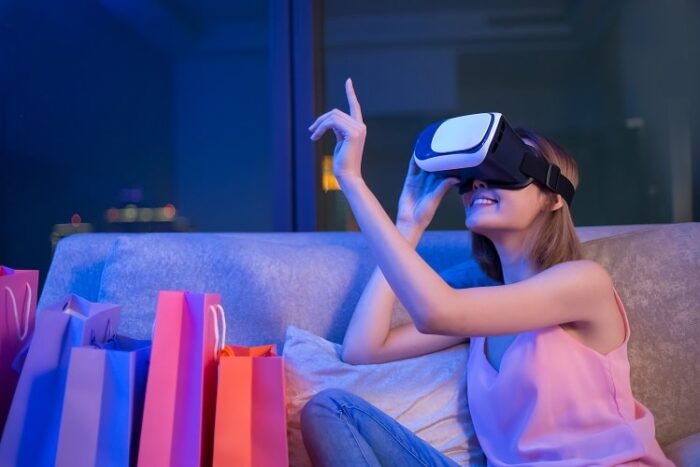
Virtual reality headsets, such as Oculus Quest 2, can provide escape and distraction from reality. While this particular headset provides gamified experiences, the same idea can be adopted to the phygital retail world, allowing consumers to walk through a store, interact with sales associates and shop, all from the comfort of their home.
Furthermore, brands must prepare for the world of 4D VR. While 4D technology can be found at amusement parks and movie theaters, within the next 10 years, 4D VR will be mass produced and accessible from mobile devices, headsets, wearables and more.
Unlike traditional VR, 4D VR adds extra dimensions such as scent and haptics to create a fully immersive experience.
In the future, imagine sitting on your couch, placing your headset on, and being front row at a concert with your friends. You can hear the music, smell the beer, feel the rumble beneath your feet. You feel your friends bumping into you as you dance the night away. When you take your headset off at the end of the night, you remember, you’re in the comfort of your own home.
CFMM 2021 Capstone Research Presentation: The Future of Consumerism
The Future of Consumerism is the focus of the 2021 annual global research conducted by the Beauty Industry’s Think Tank at FIT. The class of 2021 will share qualitative and original consumer research on global shifts in consumer lifestyle and the impact on brand and retail strategies due to the COVID-19 pandemic.
Part I of the research analyzes the new Chameleon Consumer, their evolving values, and emotional relationship to purchasing. Part II looks at The Future of Retail in a “phygital” global economy, as lines between brick-and-mortar and ecommerce continue to blur.
The webinar presentation will be held on June 23 from 5:00 pm to 6:30 pm. To register, CLICK HERE.
ABOUT FIT’S CFMM PROGRAM
The Master’s in Professional Studies in Cosmetics and Fragrance Marketing and Management is the only program of its kind. A think tank of innovative leadership, the program provides advanced education for emerging executives, fostering both creative and analytical business skills. Students obtain a global perspective through field studies in multiple overseas markets. Through academic and experiential learning, the curriculum facilitates the development of empathic leaders with the objective of shepherding brands that are global corporate citizens with products that delight and inspire the consumer.
Categorized in: Trends/Insights